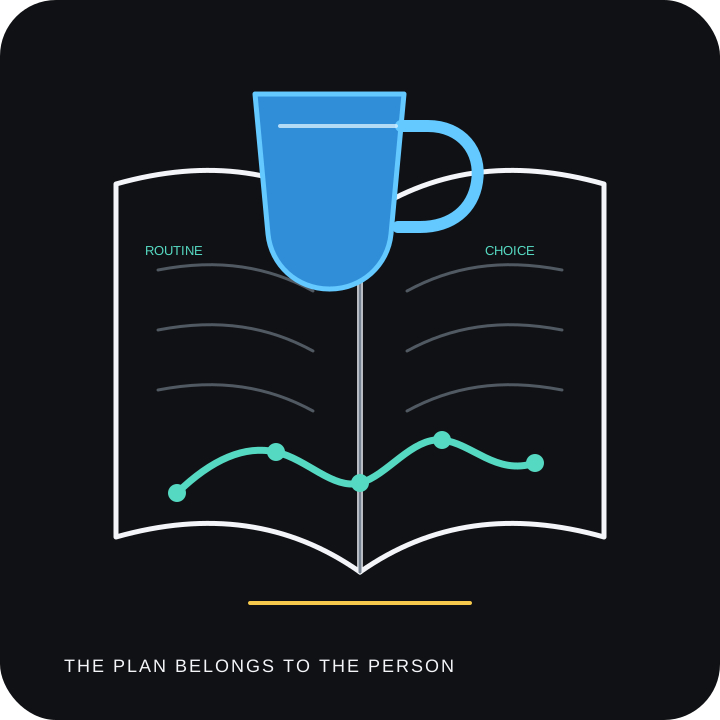
1. The blue cup
The first rule in Mina Vale’s apartment was not written down. Do not move the blue cup.
It stood upside down on the kitchen table, slightly left of center, over a black notebook with rounded corners. The cup was cheap ceramic, the blue of municipal swimming pools, chipped at the handle and marked underneath with a number 4 in silver pen. Every morning at 06:35, Tomas put it there after rinsing it. Every morning at 06:42, Mina touched the rim twice. Then breakfast could begin.
On Thursday, the cup was right side up.
Mina entered the kitchen, stopped at the threshold and listened. The refrigerator made its normal two-part hum. Pipes clicked in the wall. A delivery truck reversed somewhere below, its warning tone flattened by the closed window. Tomas did not say, “Morning, Min.” The kettle did not begin its low climb toward boiling. No spoon struck the small saucepan three times. The room contained every object and none of the sequence.
She crossed to the table and touched the cup. Dry. Cold. The notebook underneath was not aligned with the table edge. Its spine angled toward the empty chair.
Mina turned the cup upside down, placed it over the notebook and touched the rim twice.
Nothing began.
Her phone showed 06:51 in numbers large enough to read. She pressed Tomas’s picture. The call vibrated against her palm while a recorded voice said the number could not be reached. She sent the symbol they used for WHERE: a yellow circle beside a black arrow. It remained undelivered.
Mina did not live alone in the way forms defined alone. She rented her own apartment. Tomas, her older brother, lived twelve minutes away and arrived most mornings to support the parts of the routine they had divided between them. A community support worker came four afternoons a week. Her neighbor Nadi had a key for agreed situations. The pharmacy knew how she preferred labels. The librarian knew which desk lamp worked with her low vision. The seed cooperative knew Mina could identify thirty-seven varieties by touch and scent. Her life contained people. That was not the same as having a plan for the exact absence of one person.
At 07:00, Mina pressed Nadi’s picture.
Nadi answered on the first ring. “Mina?”
Mina’s speech narrowed when a sequence broke. Words remained available but arrived behind other sensations: the refrigerator hum, the bright strip beneath the blind, the rough chip on the cup handle, the phone’s warm rectangle. She said, “Cup wrong.”
“The blue cup?”
“Tomas no.”
Nadi’s voice changed without becoming louder. “Is Tomas there?”
“No Tomas. Six forty-two gone.”
“I’m coming. I’ll use the key we agreed. Is that okay?”
Mina tapped the phone once for yes, then remembered Nadi could not see. “Yes key.”
“Ten minutes. I’ll call again from outside.”
Mina ended the call and opened the cupboard. Breakfast ingredients occupied fixed shelves, but Tomas usually read the day’s plan and handled one safety-critical part of the preparation under instructions they had developed with appropriate professionals. Mina could make other breakfasts independently. The problem was not that she could do nothing without him. The problem was that Thursday’s sequence had been chosen the night before and changing it required moving through uncertainty while alarm was already filling the room.
She took bread, sunflower spread and a pear. She checked the pear by scent and pressure. She placed each item on the counter in order. Then she stopped. The black notebook waited under the cup.
Tomas called it the continuity book. He had said, for three years, that they needed to finish it. It was supposed to tell another supporter what mattered if he was ill, delayed or unreachable. Mina had refused his first version because it began with diagnoses and things she could not do. The second began with a medication table she could not read in its printed size. The third had become a stack of forms in Tomas’s apartment. The black notebook was the fourth.
As far as Nadi knew, it was blank.
Mina lifted the cup and opened the cover. Her fingers moved over the first page. Lines rose beneath the skin, shallow but deliberate. She traced a circle, then three short bars, then a shape like an open door. The page was not blank. It had never been blank.
At 07:12, Nadi called from the corridor. Mina gave permission to enter. Nadi came in carrying a canvas bag, hair still wrapped in a scarf, shoes damp from a street-washing truck. She did not hug Mina without asking. She stood where Mina could see her outline against the darker hall and said her name.
“Tomas isn’t answering me either,” Nadi said. “His phone goes straight to the network message. Do you know if he left home?”
Mina touched the notebook page. Circle. Three bars. Door.
“Blue cup plan,” she said.
Nadi looked down. “The notebook?”
“Read.”
Nadi opened to the first page. White paper. No ink. She held it toward the window, then angled it beneath the pendant light. “I’m sorry. I can’t see anything.”
Mina placed Nadi’s fingertips on the raised circle.
The neighbor’s face changed.
“Who made this?”
Mina touched her own chest.
2. Six forty-two
Nadi had known Mina for six years and Tomas for six years minus three minutes. Mina had introduced herself in the lift during Nadi’s move-in by saying, “You put the basil in darkness.” Nadi thought this was a metaphor until Mina led her to the moving box where a basil plant had been packed beneath towels. Tomas arrived three minutes later, apologized for Mina’s directness and explained her “communication style.” Nadi remembered the apology because Mina had not needed it.
Now, at the kitchen table, Nadi resisted the urge to ask Tomas’s absence to explain Mina. She asked Mina instead.
“Can you show me how to read the page?”
Mina turned the blue cup over. Its base fitted exactly inside the raised circle. She rotated the handle until the chip pointed toward the top edge of the notebook. Three sets of embossed bars extended from the circle like paths. Mina followed the first to a small square near the page corner. She reached into the drawer below the table and took out a tactile card marked with the same square. The reverse held a printed word in large black type: MORNING.
The second path ended in a triangle. Nadi found the matching card: CHANGE.
The third ended at the open-door shape: BACKUP PERSON.
“This page says what to do when the morning changes and the backup person comes?”
Mina shook her hand side to side: not exactly.
She placed the MORNING card near the bread, CHANGE beside Tomas’s empty chair, and BACKUP PERSON in Nadi’s hand. Then she took a fourth card from the drawer: ASK.
Nadi read the arrangement. Morning changed. Backup person asks.
“Ask you,” she said.
Mina tapped the table once.
Nadi had expected a list of tasks: prepare this, prompt that, call these people. The first instruction in Mina’s plan was to stop following the absent person’s routine and ask the present person.
“What do you want for breakfast?”
Mina pointed to the bread, spread and pear.
“Do you want help?”
Mina selected a card with two parallel lines: WAIT.
She prepared the meal herself. Nadi sat at the far end of the table and searched for Tomas through the channels they could use without exposing Mina’s information. She called his apartment. No answer. She contacted Suri, the community support worker, who was not scheduled until afternoon. Suri had received no cancellation. They agreed that Nadi would stay with Mina only as long as Mina wanted, Suri would contact the support organization’s duty line, and neither would invent authority they did not have.
At 07:28, Nadi called Tomas’s friend Ivo, whose number Mina selected from the agreed contact cards. Ivo answered from the wholesale flower market. Tomas had borrowed his cargo bicycle the previous evening because his own needed repair. The bicycle’s location tag, which Ivo used for theft recovery, showed it stationary near the East Canal underpass since 06:21.
Nadi did not open a map in front of Mina without context. “Ivo says the bicycle Tomas borrowed is near East Canal. He is going to check. Do you want to hear updates as soon as they come?”
Mina selected YES and DETAILS.
“Do you want me to stay?”
YES.
“Do you want Suri to come early if she can?”
YES.
“Is there anyone else you want contacted?”
Mina turned three pages in the notebook. Each looked empty until fingers found the paths. She stopped at a page with a raised spiral. The blue cup anchored the center. Paths led to symbols for LIBRARY, GARDEN and RED DOOR.
“The library?” Nadi asked.
Mina chose NO.
“The seed cooperative?”
NO.
“Red door?”
YES.
Nadi knew one red door: the entrance to Tomas’s building. Mina selected a card printed CHECK OTHER PLAN.
It took Nadi a moment. “Tomas has a continuity plan too?”
Mina tapped once.
The idea felt obvious only after Mina produced it. Care planning had orbited the person labeled dependent, while the supporter’s availability was treated as a force of nature. Tomas kept emergency contacts and health information on his phone, but if the phone was unreachable, where did his backup begin?
Ivo called at 07:36. He had found the cargo bicycle locked to a railing beside the canal. One pannier remained attached. There was no sign of Tomas. A street cleaner remembered an ambulance near the underpass around 06:30 but did not know who it collected.
Nadi told Mina exactly that: bicycle found, Tomas not there, ambulance reported, identity unknown. She did not convert unknown into reassurance or catastrophe.
Mina stood. Her chair scraped the floor. She pressed both hands over her ears, though the apartment was quiet. “Six forty-two,” she said. “Six forty-two. Six forty-two.”
Nadi reached toward her, stopped before contact and asked, “Do you want space, pressure, or help changing the room?”
Mina selected CHANGE ROOM.
They moved to the sitting room, where blinds softened the morning light. Mina sat on the floor beside a low shelf of seed boxes. Nadi placed the notebook and blue cup within reach. Mina opened to a page marked with a raised zigzag. She followed it to a card that read WHEN INFORMATION IS LATE.
The path divided into three options: KNOWN, UNKNOWN, NEXT CHECK.
Nadi wrote the time of Ivo’s update in large print on a reusable board. Under KNOWN: BICYCLE AT CANAL. AMBULANCE SEEN. Under UNKNOWN: WHO AMBULANCE TOOK. WHERE TOMAS IS. Under NEXT CHECK: IVO CALLING HOSPITAL INFORMATION LINES AND LOCAL AUTHORITIES THROUGH APPROPRIATE CHANNELS. SURI CONTACTING DUTY SUPPORT.
Mina breathed while the categories held what the room could not.
At 07:44, somebody knocked three times, paused, then knocked twice. That was not a pattern Mina had approved.
Nadi approached the door without opening it. A man’s voice said, “Delivery for Mina Vale. Medical supplies.”
No delivery was expected.
3. The blank pages
The man in the corridor wore no visible company uniform. Through the door viewer Nadi saw a white box without a shipping label. She asked him to state the provider and order number. He said the details were inside. She did not disclose whether Mina used medical supplies. She told him the delivery could not be accepted and asked him to leave contact information in the building’s secure reception area.
He left without doing so.
Nadi reported the encounter to building management and the relevant non-emergency channel, recording description and time without claiming motive. It might have been a mistaken address, a poorly handled legitimate delivery, or an attempt to gather information. Uncertainty was not permission to open the door.
Mina had moved to the hall. She held a tactile card Nadi had not seen: NO INFORMATION AT DOOR.
“This happened before?”
Mina selected ONCE and TOMAS ANGRY.
Nadi understood another weakness in the invisible care system. Tomas carried history in his reactions. He knew which door knock resembled an earlier problem, which caller used an old name, which supplier had changed packaging, which routines were preferences and which protected safety. None of that knowledge helped if it remained an instinct inside him.
Suri arrived at 08:05 after Mina consented to the schedule change. She was twenty-nine, wore a lime-green shirt because Mina could distinguish it easily, and carried no assumption that being a professional made her the lead in Mina’s home. She washed her hands, sat where Mina indicated, and asked for the update using KNOWN, UNKNOWN and NEXT CHECK.
Then she touched the notebook.
“You finished the raised pages,” she said.
Mina selected MORE.
Nadi looked between them. “You know about this?”
“Mina and I have been prototyping it at the library makerspace.”
“Tomas said the continuity book was unfinished.”
“His version is unfinished.” Suri turned to Mina. “May I explain our version to Nadi?”
YES.
The black notebook was not a complete care plan. It was an interface for building one. Standard forms had forced Mina’s life into dense tables. Digital templates timed out, used small text and placed essential instructions behind logins. Tomas’s drafts centered tasks he performed. Mina wanted a system she could navigate when speech narrowed and vision fluctuated. She and Suri had created embossed routes and matching tactile cards. The blue cup provided a stable orientation point because it was familiar, easy to find and unlikely to be confused with food while upside down. Each page represented a situation, not a diagnosis: morning changed, unfamiliar person, missed contact, power failure, leaving home, pain or illness, disagreement, information delayed.
The printed translations for supporters were supposed to live in a companion folder. Tomas had agreed to review safety-critical and provider-specific details with qualified people before they were added. He had postponed three sessions because his work schedule changed. Suri had assumed he kept temporary instructions elsewhere.
“He keeps them here,” Mina said, tapping her forehead, then pointing toward the red-door card.
“At his apartment?” Nadi asked.
YES.
They could not simply enter. Mina had a key to Tomas’s apartment for agreed emergencies, stored in a sealed pouch in her own locked cabinet. The agreement defined triggers: Tomas missing beyond a specific interval, unable to answer, and evidence of a possible emergency. Those conditions had now been met, but Mina wanted confirmation from the second person named in the agreement. She selected IVO.
Ivo was at the canal speaking with a transit officer. The ambulance had collected a cyclist after a collision with a delivery van. The cyclist had been conscious but disoriented. No name had been released to witnesses. Police had logged the cargo bicycle separately because it appeared undamaged and locked. Ivo was contacting the hospitals through their public enquiry routes.
Mina held the RED DOOR card and the key-pouch symbol. Ivo confirmed by phone that the emergency-access condition they had agreed with Tomas was met. Nadi documented the consent and trigger. Suri stayed with Mina by her choice. Nadi and Ivo went to Tomas’s apartment together.
The red door opened onto a room arranged for speed. Shoes aligned beneath a bench. Keys hung by shape. A whiteboard listed Mina’s support schedule, Tomas’s shifts at the municipal greenhouse, and three tasks marked CONTINUITY. On the desk sat a thick binder labeled MINA — COMPLETE CARE PLAN.
Nadi opened it expecting answers.
The first page was a stock photograph of two smiling hands around a mug. The next asked for date of birth, insurance number, diagnosis, legal representative and emergency contact. Tomas had filled Mina’s name, then stopped. A plastic sleeve held outdated medication information from two years earlier. Another held a schedule from before Mina moved jobs. Sticky notes covered the margins: ASK MINA HOW TO WORD THIS. CHECK WITH PHARMACIST. WHO NEEDS TO KNOW? DO NOT SHARE FULL FILE. ADD SURI. ADD NADI? CONSENT.
The binder was not negligence. It was care trapped by the fear of recording care incorrectly.
Beside it lay a red notebook titled IF I AM THE ONE WHO DOESN’T ARRIVE.
Unlike Mina’s book, this one was full.
Tomas had listed his work contact, Ivo, Mina’s support organization, building keys and the agreed emergency-access trigger. He had written: START WITH MINA’S BLACK BOOK. DO NOT ASSUME BLANK MEANS EMPTY.
Under that: THE BLUE CUP IS NOT A ROUTINE. IT IS THE HOME BUTTON.
Nadi read the line twice.
A sealed envelope in the back contained current provider and medication reconciliation contacts, marked for authorized emergency use and review dates. It did not instruct an unqualified person to administer or change anything. It told the temporary supporter where verified, current instructions were held and who could clarify them. Another page listed what Mina did independently, what help she sometimes requested, how to ask before touching, how to present options, and how stress changed her speech.
The final page said: Mina has a plan for me too. I have not asked what it says.
Ivo’s phone rang.
Tomas had been admitted to South Quay Hospital.
4. What Mina said
The hospital confirmed only the information Tomas had authorized for his emergency contacts. He was stable, undergoing assessment, and not yet able to manage calls. A clinician would contact the designated person when appropriate. Nadi did not translate stable into fine. She told Mina the exact message.
Mina selected ALIVE, HOSPITAL, WAIT.
Then she selected ANGRY.
“At Tomas?” Suri asked.
YES.
“Because he did not finish the plan?”
NO.
Mina arranged cards: TOMAS, BICYCLE, FAST, PROMISE, BROKEN.
Tomas had promised not to use the canal underpass at morning delivery time. The path narrowed where vans crossed the cycle lane. He had argued for years that the route saved four minutes. Mina had mapped an alternative. He used it when accompanying her and ignored it alone.
“He expects you to use plans he does not use,” Suri said.
Mina tapped once.
Anger gave her speech room. “Care goes both ways.”
Nadi wrote the sentence on the board because it changed the day. Everyone had arrived thinking they needed to maintain the support Tomas provided. Mina was telling them that continuity also meant preserving the responsibilities she held toward him, the greenhouse, the seed cooperative, her neighbors and herself.
Thursday was distribution day at the seed cooperative. Mina managed the tactile catalog and prepared packets for three community gardens. Tomas usually drove the crates after breakfast. If they did not arrive by noon, one garden’s school session would be canceled and another would plant the wrong drought-tolerant beans. Nadi suggested calling to cancel. Mina selected NO and PLAN.
The black notebook’s spiral page connected LIBRARY, GARDEN and RED DOOR because it was not an emergency page. It was Mina’s network page. The raised paths showed which places had people, transport, keys, quiet space, accessible toilets, charging and trusted communication. The companion cards named roles rather than private details. Mina selected GARDEN, CARGO BIKE, IVO, then crossed IVO out because he was handling Tomas’s emergency. She selected LIBRARY VAN.
The library did not have a van. It had a three-wheeled electric book cycle operated by staff and volunteers. Mina knew its morning route passed the cooperative at 10:30. She called the librarian herself. Speech narrowed again, so she used the library’s text channel with Suri available only if asked. The librarian checked insurance and cargo policy. Seeds qualified as educational materials because the cooperative ran joint workshops. The route could include the community gardens with a schedule adjustment. Mina solved a transport problem by knowing the edges between institutions.
At 09:20, she prepared to leave for the cooperative. Suri asked whether the changed morning and Tomas’s hospitalization made staying home preferable. Mina selected WORK, THEN HOSPITAL NEWS.
The care duty manager called. Because Tomas was unavailable and Suri had changed hours, the organization wanted to conduct a temporary support review. The manager asked to speak with “the family decision-maker.” Suri said Mina could speak for herself and had chosen Nadi and Ivo as contacts for specific purposes. The manager corrected course, asked Mina how she wanted the conversation conducted, and offered accessible formats.
Mina chose a short text summary followed by a call with Suri present. She approved sharing only the current schedule, communication needs and agreed contingencies. She did not consent to sending the entire red notebook or outdated binder. The manager arranged an additional support worker for evening, subject to Mina meeting and accepting the person first. A backup for Friday would be confirmed by 15:00.
“Plan works,” Mina said.
“Parts of it,” Suri replied.
Mina selected UNKNOWN.
They took the black notebook and blue cup to the cooperative. The cup traveled in a padded bag, though any object with the same base diameter could orient the pages. Mina had chosen familiarity over technical uniqueness. At the long worktable, volunteers were sorting seeds into paper packets. Light from the skylight fell too sharply on white surfaces, so Mina worked beneath the shaded lamp she had selected months earlier. She checked packet textures, tied category cords and corrected two labels.
A volunteer named Farah asked where Tomas was. Mina said, “Hospital. Not dead. More later.” The room accepted the boundary.
At 10:12, the library cycle arrived early. Its rider loaded the crates. Mina handed him a route card with large print and tactile markers. Each garden had confirmed receipt by text. A system that would have looked like charity from outside was actually an exchange: the library adjusted transport; the cooperative supplied workshop materials; Mina maintained the catalog; the gardens hosted learning. Nobody was only a recipient.
At 10:40, South Quay Hospital called Ivo. Tomas had a fractured wrist, concussion and bruising. He would remain for observation. The clinical team would decide discharge timing and instructions. He had asked one question repeatedly: “Did Mina find the cup?”
Ivo relayed the message.
Mina placed both hands flat on the table. For several seconds she made no selection. Then she said, clearly, “Tell him the cup found us.”
5. The missing hour
By afternoon, the immediate mystery appeared solved. Tomas had taken the forbidden shortcut, collided with a van emerging from a service lane, and gone to hospital without a working phone. The continuity plan, incomplete in one form and alive in another, had carried Mina through breakfast, information delay, work transport and a temporary support review.
Then Suri found the missing hour.
The hospital record placed the collision at 06:21. The ambulance left at 06:34. Tomas normally entered Mina’s building at 06:25. If he had used the canal shortcut, he should have passed the collision point around 06:12, not nine minutes later. The cargo bicycle’s route tag showed it leaving his building at 05:48—almost thirty minutes earlier than usual—and stopping twice before the canal.
Ivo assumed the tag was imprecise. Mina did not. She knew Tomas’s mornings by their edges. He woke at 05:10, sent the greenhouse humidity report at 05:30, collected bread from the night bakery at 06:14 and arrived at 06:25. On Thursdays he carried seed crates from the cooperative only after breakfast. Why had he left early with a cargo bicycle?
Mina selected RED DOOR, DESK, BOTTOM.
Nadi had seen a locked bottom drawer in Tomas’s desk but had not opened it because the emergency agreement covered continuity information, not unrestricted access. Mina held up a tactile card marked MY PROPERTY.
“Something of yours is in the drawer?”
YES.
“Do you want it retrieved?”
YES.
They documented the request and went with Ivo. The drawer key was in the sealed pouch described by Tomas’s red notebook. Inside were no dramatic secrets: a portable embossing press, heavy paper, blank tactile cards and a stack of completed pages for Mina’s continuity book. They belonged to Mina because she had designed and paid for them through an accessibility grant. Tomas had taken them home to trim the corners.
A receipt showed he had planned to deliver a second set to the community support office that morning. The office opened at 06:00 for shift changes. The first stop on the route tag matched its address. The second matched a twenty-four-hour print shop, where Tomas had collected the large-print companion pages. He was not merely traveling early. He was trying to finish the continuity system as a surprise.
At the bottom of the stack lay a cover sheet: MINA’S BOOK — SUPPORTER TRANSLATION. VERSION 1. REVIEW WITH MINA BEFORE USE.
He had not intended the pages to be used before review. Yet without them, Nadi had struggled to read the raised plan. With them, an unfamiliar supporter might mistake a draft for current instruction. The correct next step was neither hide nor distribute. It was review.
Mina laid the pages across Tomas’s floor. Each translated an embossed situation into plain language. The MORNING CHANGED page began: Do not attempt to recreate Tomas. Ask Mina what she wants to keep, change or postpone. The MISSED CONTACT page used KNOWN, UNKNOWN and NEXT CHECK. The UNFAMILIAR PERSON page required introduction, consent before entry or touch, and verification through an agreed channel. The LEAVING HOME page separated preference, essential equipment and provider-specific instruction. The DISAGREEMENT page said: Mina’s “no” is information. Do not call distress noncompliance. Reduce pressure, clarify the actual risk, and use qualified support when a safety-critical decision is unclear.
Some language needed correction. One page said Mina “becomes nonverbal,” a phrase she rejected because speech did not vanish; access to it changed. She replaced it with: Under stress, Mina may use fewer spoken words and more tactile cards. Continue addressing her directly. Another page listed foods she “will not eat.” Mina divided it into allergies or clinical restrictions, which required current verified instruction, and preferences, which were choices. The draft had combined them because both produced the same visible outcome on a plate.
On the SUPPORT NETWORK page, Tomas had placed himself at the center, with lines to every service. Mina drew a second center beside him and embossed her own symbol. Then she added connections that did not pass through either sibling: Nadi to building management, Suri to duty support, library to cooperative, Ivo to transport, pharmacy to qualified providers, Mina directly to each chosen person.
“No single failure,” she said.
The graph on the page began to resemble a seed head: many small paths, no ornamental center.
At 16:00, the evening backup worker arrived for an introduction. His name was Pavel. He spoke slowly in the exaggerated way some people used when they saw Mina’s cards. Mina selected NORMAL VOICE. Pavel corrected himself without defensiveness. He asked to read the supporter translation. Mina gave him only the pages relevant to the evening routine and emergency contact. She did not hand over the whole history of her life as an entrance fee for receiving support.
Pavel read the MORNING CHANGED page. “This says not to recreate Tomas.”
“Evening,” Mina said.
“Right. So I should not recreate Suri either.”
Mina tapped once.
They reviewed what Mina wanted that evening: receive the hospital update, eat the meal she had planned, water balcony plants, prepare Friday’s seed labels, and decide later whether she wanted company overnight. Pavel asked what help she wanted. Mina selected PLANTS—HIGH SHELF and HOT PAN. She could do the rest.
At 17:20, the hospital said Tomas might go home the next day if the clinical team was satisfied. He would need his own discharge and support plan. He could not simply resume Mina’s routine.
The care system had spent the day asking who would replace Tomas for Mina. Nobody had yet asked who would support Tomas without quietly transferring that work back onto Mina.
She turned to a new page in the black notebook. The paper was smooth.
Mina placed the blue cup in the center and began to emboss a second home button.
6. A plan in objects
The second home button began with a red plant saucer.
Mina chose it because Tomas kept one beneath the kitchen tap for propagating cuttings. Its base matched the blue cup’s diameter, and its color remained visible to her against his pale table. The object would orient his continuity pages without pretending his plan should look like hers. Familiarity mattered more than uniformity.
She embossed the first situation: SUPPORTER BECOMES PERSON NEEDING SUPPORT.
Paths led to CURRENT CLINICAL INSTRUCTIONS, HOME ACCESS, FOOD, COMMUNICATION, WORK RESPONSIBILITIES, REST, and ASK TOMAS. Mina placed ASK TOMAS first. When Suri noticed, she smiled.
“Same rule?”
“Same person rule.”
They did not complete medical or discharge sections themselves. Tomas’s clinical team would provide current instructions, and he would decide what to share with whom. They prepared questions: what tasks would be difficult with the injured wrist, what follow-up was arranged, what symptoms or changes required professional contact, what help was recommended, and who should receive the information. They distinguished the questions from answers. The blank spaces were intentional.
Mina reviewed her own supporter pages with Pavel and Suri. She approved the morning-change translation after replacing two phrases. She added dates to provider-specific contact routes and marked the medication page REFER TO CURRENT VERIFIED LIST—DO NOT COPY FROM MEMORY. The old binder’s outdated sheet went into a sealed envelope labeled OBSOLETE—DESTROY AFTER RECORD REVIEW, not back into circulation.
At 18:10, the municipal greenhouse called Tomas’s phone. Ivo answered because Tomas had authorized him for urgent work contacts. A cooling pump in propagation bay three had alarmed. Tomas normally knew which facilities technician had access after hours. The supervisor on duty had a staff directory but not the history: the primary contractor no longer serviced that controller, the replacement technician’s number had changed, and the greenhouse’s automated alert listed an equipment code nobody present could translate.
Ivo told Mina because the greenhouse was part of Tomas’s continuity plan and because she had asked for details. Mina selected GREEN CARD BOX.
At Tomas’s apartment, the green card box held plant labels, not emergency documents. Each card carried a bed number, species, sowing date and tactile notch pattern. Mina found propagation bay three by the double corner notch. On the back, Tomas had written a name and an extension: YARA—CONTROLS. The card was nine months old.
They did not assume the number remained current. Ivo called the greenhouse’s official switchboard and asked for Yara by name. She had transferred to the city energy team but was still on the authorized emergency contractor list. The switchboard connected the duty supervisor through approved channels. Yara guided qualified staff; nobody at Mina’s table attempted technical instructions. By 19:00, the greenhouse confirmed that the plant collection was stable under its contingency procedure.
Again, the needed knowledge existed. It was filed with the thing Tomas understood, not where the organization expected emergency knowledge to live.
“Why green cards not work binder?” Nadi asked when she returned.
Mina answered for him though he was absent. “Binder nobody touches.”
The statement became the evening’s design test. A continuity plan could be complete and still fail if nobody used it. It could be accessible to a professional and inaccessible to the person. It could be current but locked in one phone. It could be secure but impossible to find, or easy to find but unsafe to share. It could list tasks while erasing choices. It could name one backup who was already handling another emergency.
They spread Mina’s embossed pages, supporter translations, contact cards and Tomas’s red notebook across the kitchen table. They removed duplication. They separated information by who needed it. A temporary supporter required communication, consent, routines, current provider routes and immediate contingencies. Building management needed access requirements, not diagnosis. The cooperative needed schedule and transport, not health history. The hospital needed current clinical information through authorized channels, not the story of the blue cup. Friends needed to know what help had been requested, not what they imagined would be kind.
Mina created three sharing levels using shapes rather than colors alone. A circle meant Mina could share the information directly. A square meant share only with a named role under an agreed condition. A triangle meant ask before every disclosure. Safety-critical provider information used a separate sealed and dated method. The shapes did not replace local privacy requirements or legal authority; they made Mina’s preferences visible inside them.
Pavel asked what to do if Mina could not answer in the moment.
The question filled the room with its weight. Mina selected ADVANCE CHOICE, QUALIFIED PLAN, and DO NOT GUESS. Some situations required current professional planning beyond a homemade notebook. They listed which pages needed review with her healthcare or support professionals, which required local emergency guidance, and which were simply household preferences. The notebook stopped where expertise and formal authority began.
At 20:15, a message arrived from Tomas through the hospital’s supported communication route. His injured wrist made typing difficult. The message said: I am sorry. I am proud. Please do not finish my plan without me.
Mina dictated her reply in seven words.
WE STARTED IT. YOU HAVE TO FINISH.
Then she added the symbol for ASK.
7. The second emergency
At 21:03, water began entering Mina’s hall beneath the front door.
It was clear at first, a thin shining line. Then it carried gray dust from the corridor. Pavel smelled it before Mina saw the reflection. He did not rush to move her. He said, “Water is coming under the door. I don’t know the source. Do you want to move away from the hall while I call building emergency maintenance?”
Mina selected YES and TAKE BOOK.
The building’s main riser had failed two floors above. Water traveled through service ducts and down the stairwell. The fire system remained active, but management advised residents on Mina’s side of the floor to prepare to leave while technicians isolated the supply and checked electrical areas. The lift was temporarily taken out of service for inspection. Mina lived on the sixth floor.
The day’s care continuity exercise became an actual leaving-home problem with an unfamiliar supporter.
Pavel opened the black notebook to the raised page for LEAVING HOME. The blue cup oriented the route. Mina chose the large-print companion translation she had approved that afternoon. It began: Ask why Mina is leaving, where she is going, how long the information is expected to remain current, and who is responsible for confirming return.
They knew the reason but not duration. The designated temporary refuge was the community hall across the courtyard. Its entrance was step-free, but Mina had not visited since a lighting renovation. The building manager could not confirm whether the new emergency lights flickered in a way that affected her. Nadi volunteered to check. She did not become the designated checker until Mina agreed.
The page’s next path led to ESSENTIAL, USEFUL, LEAVE. Mina selected her phone, charger, tinted glasses, communication cards, keys, current essential information pouch, black notebook and blue cup. She left the full outdated binder at Tomas’s apartment, where it belonged. She selected no clothing bag because the move was expected to be short. Pavel asked about medicines and equipment rather than assuming. Mina directed him to the current plan and handled what she normally managed independently. They followed professional or prescribed instructions where applicable; the notebook did not rewrite them.
Water widened across the hall. The building alarm sounded—not an evacuation alarm, but an announcement whose first sentence was distorted by echo. Pavel moved toward the door. Mina held up WAIT. The notebook’s INFORMATION UNCLEAR page required confirmation through a second channel. The building text alert arrived: residents on floors five through seven, east side, should move to the community hall using the east stair if able, or contact the assistance number for individual support. The west stair was affected by water. Do not use lifts.
Mina could use stairs with time, a handrail and controlled visual conditions, but the decision was hers within the building’s current safety direction. She selected EAST STAIR, SLOW, NO TOUCH UNLESS ASK.
Pavel repeated the plan. “We use the east stair. We go slowly. I do not touch you unless you ask or there is an immediate danger I must identify. I carry the bag. You carry the cup or choose where it goes.”
Mina placed the cup inside the notebook’s elastic strap. The home button traveled with the plan.
At the stair door, three neighbors had gathered. One began giving Mina rapid instructions, each contradicting the previous. Pavel did not speak over Mina. He said, “Please give one instruction at a time and identify whether it comes from building staff.” Mina selected QUIET. Nadi arrived from below and confirmed the community hall lighting was steady, the side room was dimmer, and the accessible toilet remained open.
They descended. On the fourth-floor landing, the alarm announcement repeated. This time the echo swallowed the floor numbers. A resident turned back toward the wet west stair because he thought it said west. Nadi showed him the official text. Accessible communication was not an individual accommodation attached to Mina. It prevented a wrong turn for everyone.
In the courtyard, rain from a clear sky seemed impossible until Mina realized water was pouring from a sixth-floor balcony drain. Maintenance had redirected part of the leak away from electrical service zones. The community hall filled with residents carrying children, pets, documents, chargers and objects chosen under pressure. Some had packed too much to move easily. Others had brought nothing because the announcement sounded temporary.
Mina chose the dim side room. Pavel asked whether she wanted him inside. She selected YES, FAR CHAIR. Nadi remained available but returned to help an older neighbor contact family. Suri, off duty, checked in by text but did not insert herself after Mina said the current support was working.
At 21:42, the support organization’s duty manager called. The water incident had triggered a service alert. The manager proposed sending a second worker because Pavel was new. Mina asked what the second worker would do. The manager said “provide reassurance and oversight.” Mina selected NO EXTRA PERSON. TOO MANY.
The manager respected the choice and arranged a phone check at an agreed time instead. More support was not automatically more continuity.
At 22:10, building staff estimated residents would be out for at least four hours. Mina changed the plan. She wanted to go to Nadi’s apartment in the unaffected wing rather than remain in the crowded hall. The route required crossing the courtyard and using a different lift that had passed inspection. Building management confirmed access. Nadi agreed. Pavel’s shift was due to end at 23:00; the duty organization needed to arrange handover if Mina wanted support longer.
The notebook’s HANDOVER page had not been translated yet.
Mina found the raised paths. She placed the blue cup. The page offered CURRENT SITUATION, WHAT CHANGED, WHAT MINA CHOSE, WHAT REMAINS UNKNOWN, NEXT CHECK, and END OF ACCESS. Together they made the translation in real time. Pavel recorded only the necessary current information on a temporary sheet. Mina reviewed it. The incoming worker, Laleh, received the sheet after introduction and consent. Pavel returned his copy to Mina for destruction rather than carrying it into his next shift.
At 23:06, Mina sat at Nadi’s kitchen table. The table was round, so the notebook had no obvious top edge. She placed the blue cup over the center circle and turned the chipped handle north.
The home button worked somewhere else.
8. People who receive
The riser repair took until dawn. Mina slept for two hours in Nadi’s spare room after choosing a closed door, a low lamp and no overnight checks unless the building issued a new instruction. Laleh remained in the sitting room because Mina wanted support available but not observing her sleep. At 05:30, building management confirmed that the east apartments could return after electrical inspection.
Mina’s apartment smelled of wet plaster. Water had stopped at the hall tiles, centimeters from the seed shelf. The black notebook was dry. The blue cup had gained a second chip.
Tomas came home from hospital that afternoon with Ivo. His wrist was supported, his steps slower, and his irritation at needing help visible in the angle of his mouth. Mina waited inside the red door. She did not rush forward. She held up the ASK card.
“Ask what?” Tomas said.
She pointed to his body, his bag, then the sofa.
“Ask what help I want.”
YES.
Ivo set down the bag only after Tomas asked. They reviewed current discharge information through the appropriate channels. Tomas chose what Mina needed to know for their shared plans and what remained private. He would not support her morning routine for a period determined with his clinical team. He needed help with groceries, some household tasks and transport to follow-up. He did not need Mina or Ivo to monitor him every minute.
Mina placed the red plant saucer on his table and opened his new notebook.
“You made me one?”
“Prototype.”
He traced the first raised path with his uninjured hand. “This feels like yours.”
“Home button same. Plan different.”
Tomas began to cry. Mina waited. She did not call the tears gratitude or pain. When he looked at her, she selected SPACE or COMPANY.
“Company,” he said.
They sat without fixing the emotion.
Over the next week, continuity became less dramatic and more demanding. Schedules changed. The support organization introduced two backup workers while Suri retained her usual hours. Mina reviewed each person. One was a good match but unavailable mornings. Another had the right availability but repeatedly addressed questions to Tomas. Mina declined that worker after the trial. The organization did not frame her decision as refusal of service; it treated communication and respect as part of fit.
Nadi helped with one breakfast, then withdrew from regular morning backup because her own work began early. Her honesty improved the plan. A name on a list was not capacity. Ivo could help with Tomas but not Mina’s weekday routine. The library could support transport only on its route days. The cooperative adjusted Mina’s hours. A paid backup worker covered three mornings. On the other two, Mina redesigned breakfast and travel to use less support, with appropriate safety and professional guidance where needed.
The goal was not replacing Tomas minute for minute. It was separating tasks that existed because of habit from support Mina actually chose or required.
They discovered that Tomas had been doing seventeen recurring things. Mina wanted continued help with six. She could do four independently if objects were rearranged or information changed format. Three could move to other times. Two belonged to building or service providers rather than family. One—the ritual of striking the saucepan three times—was not help at all. Tomas did it because their mother had done it. Mina disliked the sound and had tolerated it for eleven years.
“Why never tell?” he asked.
“You like.”
“That isn’t a reason.”
“Care goes both ways.”
He laughed, then winced because laughing hurt his bruised ribs. “We are going to misuse that sentence for the rest of our lives.”
The continuity review reached beyond the siblings. The seed cooperative asked every key volunteer to map what stopped if they were absent. The library documented the accessible lamp settings and text contact route so knowledge did not reside in one librarian. The greenhouse revised its after-hours controls directory through official systems and scheduled reviews. Building management rewrote emergency announcements to lead with action, location and timing, duplicated them in text, and added a process for residents to record access requirements without public disclosure.
Nadi created her own page for the community pantry she coordinated. Suri asked the support organization why continuity templates began with impairment rather than communication and consent. Pavel became an advocate for returning temporary notes at handover. Laleh suggested a formal “end of access” step so former temporary supporters knew when not to retain information or keys.
Mina watched the plan spread and stopped it when people called it her inspiration. She had not performed a brave act for their improvement. She had built a tool because the existing one did not work.
At a neighborhood meeting, a coordinator introduced her as “our most vulnerable resident.” Mina took the microphone.
“Water came under my door,” she said. “Pavel needed my plan. Tomas needed my plan. Greenhouse needed my card. Nadi needed my door rule. Vulnerable to what? Bad information. Broken pipe. One person knowing everything. Fix nouns.”
The minutes recorded: Replace labels about vulnerable people with specific barriers and responsibilities.
After the meeting, the coordinator apologized. Mina accepted the apology and asked for the revised form by Tuesday.
9. The rehearsal
Three months later, Mina scheduled a rehearsal for 06:42.
Tomas would not arrive. This time everyone knew. The backup worker, Laleh, would use the continuity card and black notebook. Suri would observe only with Mina’s permission. Nadi would be unavailable on purpose. Ivo would not answer during the first check. The support duty line knew it was an exercise. No emergency services or clinical providers would be contacted as part of the simulation. If a real problem occurred, the rehearsal would stop.
They designed failure into it carefully. The blue cup would be in the wrong cupboard. The printed supporter page would contain one outdated bus time marked with an old review date. The building text channel would issue a fictional maintenance notice clearly labeled EXERCISE. Mina would decide whether to continue the planned morning or choose another.
At 06:35, Laleh entered with permission. She looked for the cup, did not find it, and asked Mina whether another object could orient the notebook. Mina selected YES and chose a jam jar with the same base. First lesson: a familiar anchor helped, but the plan could not depend on one ceramic object surviving forever.
At 06:42, Laleh opened MORNING CHANGED. She asked what Mina wanted to keep. Mina chose breakfast and work. She postponed watering because the fictional maintenance notice said the building would interrupt water. Laleh read the bus time, noticed the review date had passed, and verified the current schedule through the official accessible channel. Second lesson: a plan needed dates and sources, not merely confident print.
Ivo’s simulated unavailability triggered the second-contact route. The card named Nadi, but Nadi was intentionally unavailable. Laleh reached the support duty line, which had the current authorized contact. Third lesson: two backups could fail together, and a service-level route mattered.
The exercise exposed a more subtle problem at breakfast. Laleh asked whether Mina wanted “the usual.” The phrase appeared harmless. Mina selected UNKNOWN. There was no single usual; preferences changed. The supporter page had instructed ASK, but conversational habit collapsed the choice into routine. They revised the page: Offer concrete current options. Do not use “usual” when it hides a choice.
At the building entrance, the fictional notice moved the bus stop. The backup route required a crossing whose audio signal had been broken the previous week. Mina knew this because she had reported it. The continuity card did not. They added live route verification to the morning plan and clarified who would check.
At the cooperative, a volunteer saw Laleh and asked, “Where is Tomas?” Laleh almost explained the rehearsal. Mina answered, “Not your information.” They added a privacy scenario: supporters should not narrate the reason for changed support to curious people unless Mina chooses.
The rehearsal ended at 09:00. Nobody received a certificate. They sat around the worktable and listed what had failed.
The blue cup was a single point until they defined substitutes. Contact backups shared the same likely unavailability. One printed time was stale. “Usual” hid choice. Route evidence had expired. Privacy leaked through friendly conversation. The plan required reading skill and tactile familiarity a completely new supporter might not have. The embossed symbols had no standardized meaning outside Mina’s system. Each weakness became a revision with an owner and review date.
They also listed what worked. Mina could orient and control the plan. Laleh asked rather than guessed. Information was separated by purpose. Unknowns remained visible. Safety-critical details pointed to current qualified sources. Temporary notes were returned. The exercise did not test Mina as if she were the equipment. It tested the system around her.
Tomas arrived at 09:15 with pastries and his red saucer. His wrist had healed enough for work, but the morning routine no longer returned to its previous shape. He supported one breakfast a week because they both wanted the time. Paid support covered two. Mina used redesigned independent routines on two. Weekends changed according to plans rather than tradition.
“How did I do?” he asked.
“You were absent correctly,” Mina said.
“Finally, a strength.”
He showed them his own rehearsal results. Ivo had practiced collecting current discharge or provider information without sharing it too widely. The greenhouse had tested an after-hours alert with Tomas unavailable. The first technician called was outdated. The second lacked site access. The third resolved the simulated fault through approved procedure. The organization updated its directory.
Mina placed both notebooks side by side. Blue cup, red saucer. The raised networks differed. The principle beneath them did not: no person should have to become an emergency before a system learns what they know.
Suri photographed the notebooks only after both owners approved, with pages closed and no private information visible. The support organization wanted to develop an accessible continuity toolkit with people who used services as paid co-designers. Mina agreed to discuss it if the contract recognized her work, allowed withdrawal and did not turn her personal symbols into a universal template.
“The cup is mine,” she said.
The director wrote it into the project boundaries.
10. Under the cup
A year after Tomas missed 06:42, the blue cup broke.
It fell from the drying rack while nobody was in the kitchen. The handle split away. A fracture ran through the base, dividing the silver number 4. Mina found three pieces on the floor and stood over them without speaking.
Tomas arrived at 07:00 for their weekly breakfast. He saw the pieces and stopped at the threshold. The old morning would have collapsed around the object. The new plan did not pretend loss was easy. It offered choices.
Mina selected TIME, THEN REPLACE.
They left the pieces where they were until she was ready. Later, wearing appropriate protection for cleaning broken ceramic and following ordinary household safety, Tomas collected them into a box. Mina chose a white cup from the cupboard. Its base was too wide. The jam jar worked but felt temporary. At the cooperative, Farah offered a blue enamel cup whose base matched exactly. It had no handle and could not break the same way.
Mina placed it over the notebook’s circle. The plan oriented.
She disliked it.
Continuity was not interchangeability. An object could perform the function and still fail the person. She used the jam jar for two weeks while searching. At a repair café—not for restoring a drinking vessel to food use, but for discussing safe ways to preserve the pieces as a nonfunctional object—an artist suggested mounting the broken cup on a small board. Mina approved a design that kept the chipped handle pointing north. The original cup became a tactile wall marker beside the table. A new ceramic cup, chosen by Mina, became the movable home button.
The notebook changed too. Its pages were now one layer in a continuity system: embossed routes controlled by Mina; short supporter translations; current sealed professional information through appropriate channels; purpose-limited contact cards; a review calendar; and rehearsals. Digital copies existed in accessible formats for people Mina authorized, with secure handling defined by the relevant services. Paper remained because batteries, accounts and networks failed. Neither medium was treated as infallible.
The personality of the plan remained unmistakably hers. It used objects, direct verbs, categories for unknown information and a refusal to center the helper. Another person’s plan might use photographs, audio, sign language, plain text, symbols, a trusted interpreter, a formal care record or something entirely different. The lesson was not to copy the cup. It was to design with the person who needed continuity.
Mina’s paid co-design project produced eleven prototypes and rejected nine. One failed because it stored too much sensitive information in one portable folder. One relied on color. One assumed literacy. One required cloud access. One treated a family member as permanently available. One used “challenging behavior” without recording pain, communication or environmental triggers. One had no way to withdraw consent. One made the plan so simple it omitted safety-critical professional instructions. One was beautiful and impossible to update.
The two surviving approaches shared only a framework: communication and consent first; strengths and independent actions visible; essential routines separated from preferences; current qualified instructions clearly sourced; backups with capacity and agreement; information divided by purpose; offline and accessible options; review dates; rehearsal; and a defined end to temporary access.
The organization published the framework, not Mina’s private plan. It paid the co-designers. It linked to local professional, privacy and emergency guidance. It stated what the toolkit could not decide.
Tomas returned to cycling after his clinical team cleared him. He never used the canal underpass at delivery time. Mina did not accept his promise as infrastructure. The city installed a protected junction treatment after a campaign involving cyclists, delivery drivers, local businesses and access groups. Until then, Tomas’s route plan showed the longer alternative and a review date.
On Thursdays, the library cycle still carried seed packets. The cooperative expanded its tactile catalog. The greenhouse’s contact directory survived three staff changes because review belonged to a role, not Tomas’s memory. Building announcements began with the floor, action and affected route. Nadi’s basil occupied the brightest place in her apartment.
At 06:42 on the anniversary morning, Mina touched the rim of the new cup twice.
Tomas waited.
She opened the notebook to MORNING CHANGED, though nothing had gone wrong. The page’s first route led to ASK. She placed the card between them.
“What do you want for breakfast?” he asked.
Mina selected bread, sunflower spread and a pear—the meal she had made on the morning he disappeared.
“Help?”
She selected COMPANY.
They prepared it together. Tomas did not strike the saucepan. The room held the refrigerator’s two-part hum, pipes clicking in the wall and the soft scrape of a knife across bread. Ordinary sounds, returned without being restored to their old arrangement.
After breakfast, Mina turned to the final page. The blue cup’s base fit the central circle, but this page had no raised paths. It held a single embossed sentence that Nadi had once mistaken for blank paper.
Mina guided Tomas’s fingers across it.
THE PLAN IS NOT WHAT PEOPLE DO TO KEEP ME GOING.
Below it, a second line:
THE PLAN IS HOW WE KEEP KNOWLEDGE, CHOICE AND CARE MOVING WHEN ANY ONE OF US CANNOT.
Tomas traced the words again.
“You wrote this before the accident?”
Mina nodded.
“Why didn’t you show me?”
She selected WAIT.
He waited.
Then she placed the broken handle from the first cup beside the new one. The old chip pointed north. The new cup cast a blue shadow across the page, revealing nothing that fingers had not already known.
“You were reading for ink,” Mina said.
Coda. The line that was missing
That afternoon, a package arrived from the municipal records office. It was addressed to Mina in large print, with the tactile corner notch she had requested after three earlier envelopes arrived indistinguishable from advertising. The return label named the protected-junction consultation. Inside was the final design response, a map and a short note: Your evidence has been incorporated.
Mina distrusted the sentence immediately.
“Which evidence?” she asked.
Tomas searched the document. It thanked residents, businesses and transport groups. It described traffic counts, vehicle turning paths and delivery windows. It included the time of Tomas’s collision, anonymized as one incident among twelve. It did not include the route barrier Mina had reported: the temporary sign that narrowed the footway, forcing people who used mobility aids or guides closer to the turning traffic. It did not include the inaccessible notice format that had prevented several residents from understanding the detour. The evidence had been “incorporated” by shrinking it to the part the engineers already knew how to count.
Mina placed the blue cup over the map’s legend. The base covered the symbols for pedestrians, cycles and deliveries. Three systems disappeared beneath one familiar object.
“Meeting,” she said.
The consultation team offered a video call. Mina asked for the agenda, accessible documents and decision owner in advance. She asked who could change the plan after the meeting and whether the drawing was final. The first reply praised her engagement without answering. She returned it with the unanswered questions numbered. The second reply named the project engineer, accessibility lead and procurement deadline. The plan could still change for nine days.
At the meeting, the engineer began with a presentation. Mina held up STOP before the second slide.
“You said my evidence is here. Show where.”
The cursor moved across the map. It hovered at the crossing, the delivery bay and the collision marker. The accessibility lead said the narrowed footway was “outside the immediate collision scope.”
Mina selected CONNECTED CAUSE.
Tomas remained silent. A year earlier he would have translated the phrase into a speech of his own. Now he waited while the meeting facilitator read Mina’s communication note and asked a direct question: “Do you mean that excluding the footway condition makes the collision analysis incomplete?”
YES.
The delivery driver who had struck Tomas joined the call from a union office. His name was Petar. He had asked to participate and had not contacted the family privately. The police and insurance processes had followed their separate routes. This meeting concerned the street.
Petar said the navigation system assigned deliveries through the underpass during the prohibited window because its commercial map had not received the city restriction update. His employer’s dispatch screen showed the route as valid. He had seen the temporary footway sign, the cyclist and a van emerging from the service lane in the same four seconds. He braked too late.
“I made the error,” he said. “The system made the error easy.”
The sentence did not erase responsibility. It enlarged the field of prevention.
The engineer reopened the drawing. The team added a protected waiting area, moved the loading turn, widened the footway around permanent equipment and replaced the temporary sign arrangement. Procurement added a requirement for accessible detour information. Transport operations assigned ownership for updating commercial route data when time restrictions changed. The union proposed a driver reporting channel for conflicts between dispatch instructions and street conditions. Each action received a name and date.
Then Mina asked the question that changed the room.
“Who is absent from this plan?”
Nobody answered at first. The map showed users as colored arrows. It did not show anyone who could not see the arrows, anyone who could not join a video consultation, anyone who traveled at night, anyone whose route depended on a support worker’s shift, anyone who avoided the underpass after an earlier near miss, or anyone whose evidence had never reached the office because the form rejected audio and paper submissions.
The accessibility lead proposed another consultation. Mina selected NO LOOP.
“Change method now.”
They agreed to accept evidence by accessible web form, phone, audio, paper, supported meeting and community collection point. They published what decision each comment could influence, what had already been fixed, and how contributors would learn the outcome. They scheduled a paid review with people whose access needs had been excluded from the first process. Consultation stopped meaning an invitation to react to a nearly finished object. It became part of making the object.
Nine days later, the revised drawing returned. Mina checked the footway, detour communication and evidence routes. Tomas checked the cycle turn. Petar checked the loading geometry with drivers. A cane user found a pole positioned inside the guidance path. A parent using a wide adapted stroller found that the refuge angle required an impossible turn. Both defects existed in the “accessible revision.” Both were corrected before procurement.
The construction finished in autumn. On opening morning, officials placed a ribbon across the cycle lane. Mina pointed out that the ceremony had blocked the route it celebrated. The ribbon moved.
She and Tomas crossed at 06:42. Delivery vehicles waited behind the timed signal. The footway remained wide around the corner. A tactile and high-contrast notice explained the temporary finishing work. It named a contact and removal date. None of these details guaranteed safety forever. They made responsibility easier to locate.
At the far side, Tomas took the broken cup handle from his pocket. He had carried it without telling Mina.
“I thought we could leave it here,” he said.
Mina selected NO.
He looked embarrassed. “Too sentimental?”
“Litter.”
They laughed. Then Mina selected KEEP, NOT SHRINE.
Back home, she placed the handle in a shallow drawer beneath the notebooks. The drawer also held expired cards, replaced labels and the first failed supporter translation. Nothing inside remained operational. Everything inside showed how the working system had changed.
She embossed a label for the drawer: EVIDENCE, NOT INSTRUCTION.
Tomas read it twice. “That belongs on half the world.”
Mina opened the black notebook to a new page. She placed the blue cup at its center and pressed the embossing tool into the paper. One path ran to KEEP. One ran to CHANGE. One ran to ASK WHO IS MISSING. One ran beyond the edge of the page and stopped without a label.
“What is that one?” Tomas asked.
Mina touched the unfinished line.
“Next person knows.”